Pastoral Letter 32
Dear Members of St. Andrew’s Uniting Church, Friends and Adherents,
Grace and peace to you all in the name of our Lord and Saviour Jesus Christ.
I hope you and your loved ones are well and safe. I trust you had a good week, regardless the strange circumstances we are still in with the veil of pandemic still hanging above us, with outbreaks here and there. We are glad that we had rare cases and as if we are heading towards a breakthrough. The church Elders and Council met last Wednesday and reconsidered the possibility of reopening our church doors, starting with our Sunday Morning Service with the possibility of singing, though with some restrictions. The meeting unanimously decided that mid-November will be a good time to resume our services, considering there are many requirements to cover the COVID safety plan, before resuming any activities on our premises. That’s really good news, not to the say the best news for us. The meeting agreed that we target 22 November to be our first worship as a firs trial and formally start worshiping together on St. Andrew’s Day 29 November, inviting our neighbours to join us. This will be finalised in our November meeting, which will be held on Wednesday 4 November, with the hope that things will be much better then.
I guess you have been waiting for a very long time to hear this good news of the possibility of resuming our services that we missed for such a long time. I urge you to pray hard for this to happen by the grace of God. We will keep you posted. In the meantime, please join the other members tomorrow morning in worship, following the Order of Service. This week we will use the John Flynn Foundation Order of Service, as we did last year. Please light a candle, follow the order and be aware that I have added two more hymn, “ You Were in This Place” which should be sang at the start of the Service and “Fill Thou My Life, O Lord My God”, which should be sang before the Readings. Give a little more time for your personal prayers and pray for others. The message, in a form of John Flynn story, is prepared by our dear friend Bob Minton. Thank you, Bob, for doing this.
Also, we would like to let you know that we will not have our AGM, which we used to hold in October, instead send around the reports seeking your approval. The reports will be ready within a fortnight and circulated. If you have any matter that you would have brought to the AGM, we kindly ask you to let Penny, Chris or me know about it.
Still the situation in Armenia and Artsakh is escalating and intensifying, targeting many civilians and populated major cities, towns and villages including the capital Stepanakert. The number of causalities is going up rapidly, almost half of the population of Artsakh have left their homes and moved into Armenia. Those who have decided to stay, are in the shelters. Sadly, Shushi’s Khazanchechots church was deliberately hit by Azeri forces heavy artillery fire causing major destruction. Our people are crying for PEACE. We are called to pray for peace, raise awareness in our surroundings and share our material resources to sustain the people, support the victims of war, care for the wounded and the misplaced. Please continue to pray for Armenia. May God be with the suffering Armenian nation.
Continue to pray and remember the following points in your prayers:
1. Pray for Armenia and Artsakh as the violent war continues with the number of casualties are growing day by day, including civilians, young and old, women and children.
2. Pray seeking God’s help as we go through the difficult time of pandemic.
3. Pray for those who are struggling financially, lost loved ones, in pain, not well and lonely.
4. Pray for world peace and ask for God’s blessings.
5. Pray as we plan to reopen our doors for worship in November.
Krikor
JOHN FLYNN
THE MAN ON THE TWENTY DOLLAR NOTE
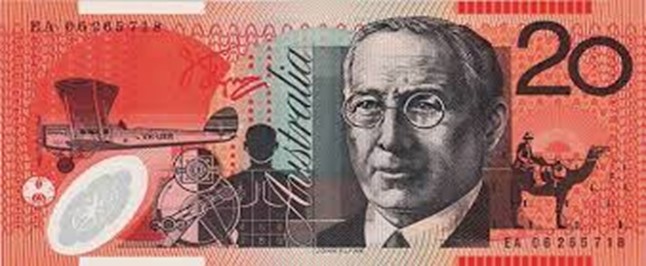
Reverend John Flynn – “Flynn of the Inland “
In these times it seems that heroes are acclaimed readily and easily. A single television appearance coupled with a politically correct question elevates the newcomer to heroic status in the twitter universe. Only days later, it seems too often the case, a modest due diligence reveals our latest ‘hero’ actually has feet of clay.
But David Bowie was absolutely right in his Heroes album: it is possible to be a hero just for one day.
John Flynn, “Flynn of the Inland” was an authentic Australian hero, who bequeathed the nation a very great deal by virtue of good judgement, hard work and continuing sacrifice. Flynn is best remembered as the founder of the forerunners of the Royal Flying Doctor Service, which has saved countless Australian lives through bringing medical care to the most remote corners of Outback Australia. However, this is but one of Flynn’s achievements, in a life seen as perhaps even more remarkable when viewed at a distance.
In the late 19th Century, the Christian churches in Australia became increasingly concerned for the welfare of people living in the Outback. The establishment of the Smith of Dunesk Mission based at Beltana in South Australia in 1894 enabled a series of Presbyterian Ministers to be sent to the areas north of Beltana; they also established a nursing service at Oodnadatta in 1907.
John Flynn was born at Moliagul in central Victoria in 1880 and after a stint teaching, served as a Home Missionary at Beech Forest and Buchan in rural Victoria between 1903 and 1906.
In 1902 a Methodist Minister the Rev. Alfred Thomas Holden, ‘Colonel Holden’ returned from the Boer War where he had served as an Army Chaplain. In 1904 he became Secretary of Methodist Home Missions which serviced remote rural congregations across Victoria.
By 1910 John Flynn who was now in his 3rd year at theological college had written ‘The Bushman’s Companion’ a comprehensive guide for those living in the bush, remote from education, legal and medical support. It contained prayers, instructions on how to write a Will and how to set a sling for a broken arm. For John Flynn every aspect of a person’s life was equally important to and of interest to God.
Ordained in early 1911 he was sent to the Smith of Dunesk Mission at Beltana in South Australia. While he was there the Presbyterian Church commissioned him to look at the needs of Outback people. His report to the Presbyterian General Assembly in Melbourne on 26 September 1912 resulted in the establishment of the Australian Inland Mission (AIM) with Rev. John Flynn appointed as its first Superintendent.
The first AIM “Patrol Padres” went out in 1913 by camel and horse from Pine Creek, Beltana, Broome and Port Hedland to provide pastoral care and counselling services to people on isolated properties, small communities and mining sites.
Hand in hand with these patrols was the need for medical services and Flynn established nursing clinics in iconic places like Alice Springs, Innaminka & Birdsville. Nursing Sisters travelled by camel, horse, rail and even motor tricycle. Two-year terms and two nurses to a clinic was the normal practice.
Flynn believed improved communications especially between properties and the AIM nursing clinics were another way to overcome Outback isolation. With his encouragement, the pedal wireless invented by Alf Traeger in 1926 featured an easy to operate generator operated by pedal power similar to a bicycle.
John Flynn’s vision of providing a “Mantle of Safety” (as he called it) for the people of the Inland can be traced to the years immediately preceding World War I, when the Presbyterian Church’s Australian Inland Mission (AIM) was one of several church bodies undertaking missionary way in the Inland.
The AIM was conscious of the terrible isolation of Inland people, who were so remote from medical and religious care. John Flynn began his missionary work in 1912, at a time when only two doctors served an area of some 300,000 square kilometres in Western Australia and 1,500,000 square kilometres in the Northern Territory. It did not take long to realise that air transport and radio were needed to break the isolation of the Inland and to provide adequate medical care for its people. However, John Flynn had to wait many years before he could translate his vision of a flying doctor service into practice.
Aircraft at that time were not suited for ambulance work and radio was then very much in its infancy. In October 1918 John Flynn published an article outlining the feasibility of air transport in the Inland and its possible use for air ambulance work. The article was written by a young Australian medical student, Clifford Peel who was killed in action, in France during World War I, while serving with the Australian Flying Corps. However, as developments demonstrated, Peel was ahead of his time. Despite the great difficulties facing him, John Flynn continued to work towards the fulfillment of his vision with an extraordinary tenacity that was borne out of true compassion for the people of the Inland.
The story of the Royal Flying Doctor Service is forever linked with its founder, the Reverend John Flynn – “Flynn of the Inland “
It was in 1928, John Flynn established the Aerial Medical Service which in 1938 became a separate organisation called the Flying Doctor Service. It became the Royal Flying Doctor Service during the Queen’s visit to Australia in 1954.
On 31 May 1926 the General Conference of the Methodist Church meeting in Brisbane established the Federal Methodist Inland Mission (FMIM) with Rev. AT ‘Colonel’ Holden as its first Director. The Conference Appendix Minutes state that they will ‘work together’ with those who are already engaged in this important work. i.e. with the John Flynn and the AIM – over 50 years before the Presbyterian and Methodist Churches along with the Congregational Church formally became the Uniting Church!! In the 1920’s such cooperation across the denominations was very rare, with people rarely fraternising with those outside ‘their denomination’.
Because working and living in remote Australia was so different to anywhere else, Flynn & Holden believed that a radical new approach was needed if the AIM and the FMIM were both to be engaged meaningfully and productively in this work across remote Australia.
The people of the Outback by and large weren’t interested in what denomination you may be but rather whether the support you can give will make a difference to their daily lives.
Flynn and Holden agreed that where one organisation provided a Patrol Padre in a particular place that the other would if possible, establish a nursing clinic and visa-versa.
In June 1933 Flynn was awarded an OBE for his services to remote Australia and in 1966 his achievements were immortalised on the new $20 Bank Note.
By the beginning of WW II, the AIM had 64 pedal wireless sets across their network of nine hospitals, seven Patrol Padres, eight shared Mission and Welfare Centres and three Aerial Medical Service bases; by then the Methodist Inland Mission had a similar number of Patrols but fewer nursing clinics.
In 1949 the AIM opened its first age care facility ‘Old Timers’ in Alice Springs.
“School of the Air” is a generic term for correspondence schools catering for the primary and early secondary education of children in remote and outback Australia where some or all classes were historically conducted by radio, although this is now replaced by telephone and internet technology. In these areas, the school-age population is too small for a conventional school to be viable.
The first ‘School of the Air’ in Australia was established at Alice Springs on 8 June 1951. The radio network, maintained by the Royal Flying Doctor Service, was used by the school to make two-way broadcasts to the children in that area via HF Radio.
John Flynn who married Jean Baird in 1932 died aged 70 on 5 May 1951
When Flynn died in 1951 the ABC radio went silent for two minutes in honour of his passing and contribution. A silence never repeated.
On the death of John Flynn, the Rev. Fred McKay was appointed Superintendent of the AIM, a role he served in until January 1974.
Flynn & Holden’s vision for Outback people continues to be implemented today.
On 22 June 1977 the formation of the Uniting Church in Australia saw the complete coming together of the AIM & FMIM and the outback work of the Congregational Church into what is now called Frontier Services.
Flynn’s vision for the “mantle of safety” for Outback people continues to be implemented today through Frontier Services. It is still the welcome visitor, the friend, the counsellor and advocate for the people of remote Australia.
When some of us visited Broken Hill, earlier this year we had the great privilege of visiting the RFDS base at Broken Hill airport and sat in on a lesson at the School of the Air
Today’s gospel reading
Matthew 25:35-40
35For I was hungry and you gave me food, I was thirsty and you gave me something to drink, I was a stranger and you welcomed me, 36I was naked and you gave me clothing, I was sick and you took care of me, I was in prison and you visited me.’ 37Then the righteous will answer him, ‘Lord, when was it that we saw you hungry and gave you food, or thirsty and gave you something to drink? 38And when was it that we saw you a stranger and welcomed you, or naked and gave you clothing? 39And when was it that we saw you sick or in prison and visited you?’ 40And the king will answer them, ‘Truly I tell you, just as you did it to one of the least of these who are members of my family, you did it to me.
John Flynn was certainly a man who saw the problems of living in remote Australia, but he could also see the solutions!!
John Flynn also had the unique capacity to gather around him very capable people.
Clifford Peel, the young airman who saw the vision of aeromedical flights was killed at the end of WWI in France before being able to assist with bringing the dream to reality. He did however leave money in his estate to the AIM.
Alf Treager was the man who developed the pedal radio which connected remote properties with the Flying Doctor Bases and with properties to each other
Adelaide Miethke, councillor of the Flying Doctor Service suggested using the radio network to assist parents with home schooling and so commenced the School of the Air
Hudson Fysh, of Qantas fame, assisted John Flynn to source suitable aircraft for medical retrieval services.
When we read and learn of men like John Flynn, we can thank God that they see the vision and despite difficulties, with His power they achieve great things in the name of our Church and our God.
AMEN!
Bob Minton